AI Productivity Tools 2026: Boost Workflows by 15% with Practical Solutions

Unlocking 15% More Productivity: How AI-Powered Tools are Redefining Workflows in 2026 (PRACTICAL SOLUTIONS)
In an increasingly competitive global landscape, the quest for enhanced productivity is no longer a luxury but a necessity. Businesses and individuals alike are constantly searching for innovative ways to optimize their operations, reduce manual effort, and free up valuable time for strategic thinking and creativity. Enter AI productivity tools – a rapidly evolving domain that is not just promising, but already delivering significant gains. By 2026, experts predict that the integration of AI could lead to a remarkable 15% increase in overall productivity across various sectors. This isn’t merely about incremental improvements; it’s about a fundamental redefinition of workflows, enabling us to achieve more with less, smarter and faster.
The concept of artificial intelligence has moved beyond the realm of science fiction and is now an integral part of our daily professional lives. From automating repetitive tasks to providing intelligent insights, AI is reshaping how we work, collaborate, and innovate. This comprehensive guide will delve into the practical solutions offered by AI productivity tools, explore their real-world applications, and provide a glimpse into the future of work. Whether you’re a business owner looking to scale, a team leader aiming for greater efficiency, or an individual professional seeking to reclaim your time, understanding and leveraging these tools will be paramount to your success.
The Dawn of a New Era: Why AI Productivity Tools are Indispensable
The traditional understanding of productivity, often measured by hours worked or tasks completed, is undergoing a profound transformation. The rise of AI productivity tools is shifting the focus from sheer volume to intelligent output. It’s about working smarter, not just harder. Several key factors underscore why these tools are becoming indispensable:
Addressing the Repetitive Task Burden
One of the most significant drains on productivity in any organization is the sheer volume of repetitive, mundane tasks. Data entry, scheduling, email management, routine report generation, and basic customer inquiries consume countless hours that could otherwise be spent on complex problem-solving, strategic planning, or creative endeavors. AI is exceptionally good at handling these predictable, rule-based operations. By automating such tasks, businesses can reallocate human capital to higher-value activities, leading to increased employee satisfaction and a more strategic workforce.
Enhancing Decision-Making with Data-Driven Insights
In today’s data-rich environment, the ability to quickly and accurately analyze vast datasets is a competitive advantage. AI-powered analytics tools can sift through mountains of information, identify patterns, predict trends, and provide actionable insights far beyond human capabilities alone. This empowers decision-makers to make more informed choices, optimize resource allocation, and respond proactively to market changes. From marketing campaign effectiveness to supply chain optimization, AI productivity tools are transforming how businesses leverage their data.
Fostering Seamless Collaboration and Communication
Effective communication and collaboration are the bedrock of any successful team. However, miscommunication, information silos, and inefficient meeting structures can severely hamper productivity. AI is stepping in to bridge these gaps. Tools that transcribe meetings, summarize discussions, translate languages in real-time, and intelligently route information are making collaboration smoother and more inclusive. This is particularly crucial in an era of distributed and remote workforces, where clear and concise communication is paramount.
Personalizing Workflows for Optimal Performance
No two individuals or teams work exactly alike. AI productivity tools are increasingly capable of learning individual preferences and optimizing workflows accordingly. This personalization can manifest in intelligent task prioritization, customized content recommendations, adaptive learning paths, and even predictive analytics that anticipate needs before they arise. By tailoring the work environment to individual strengths and habits, AI helps each professional operate at their peak performance.
Practical Solutions: Top AI Productivity Tools for 2026
The market for AI productivity tools is booming, with new solutions emerging constantly. Here’s a breakdown of key categories and examples that are set to define productivity in 2026:
1. Intelligent Automation Platforms
These platforms are the backbone of workflow transformation. They go beyond simple task automation, integrating with various systems to create end-to-end automated processes.
- Robotic Process Automation (RPA) with AI: Tools like UiPath and Automation Anywhere are integrating AI to handle more complex, unstructured data. They can automate processes involving legacy systems, read invoices, extract data from documents, and even perform cognitive tasks that require a degree of understanding.
- Workflow Orchestration Tools: Platforms such as Zapier and Make (formerly Integromat) are becoming smarter, using AI to suggest automation flows, identify bottlenecks, and even self-correct certain processes based on learned patterns.
2. Advanced Communication & Collaboration Assistants
These tools are designed to make communication more efficient and meetings more productive.
- AI-Powered Meeting Assistants: Tools like Otter.ai and Fathom AI can transcribe meetings in real-time, identify speakers, summarize key discussion points, extract action items, and even integrate directly with project management software. This eliminates the need for manual note-taking and ensures no crucial information is missed.
- Smart Email Management: AI-driven email clients (e.g., Superhuman with AI features, Google Workspace’s AI enhancements) categorize emails, suggest responses, prioritize important messages, and even draft entire emails based on context, significantly reducing inbox overload.
- Real-time Translation & Localization: For global teams, AI translation tools embedded in communication platforms (like Microsoft Teams or Zoom) are breaking down language barriers, enabling seamless cross-cultural collaboration.
3. Data Analysis and Business Intelligence (BI) Tools
Leveraging AI to extract meaningful insights from data is crucial for strategic decision-making.
- Natural Language Processing (NLP) for Data Query: Tools like Tableau and Power BI are incorporating NLP, allowing users to ask questions in plain English and receive instant data visualizations and insights, democratizing data analysis for non-technical users.
- Predictive Analytics Platforms: AI models can forecast sales trends, customer churn, resource needs, and market shifts with increasing accuracy, enabling businesses to plan proactively and optimize strategies.
- Automated Report Generation: AI can compile data from various sources and generate comprehensive reports, dashboards, and presentations, saving countless hours for analysts and managers.
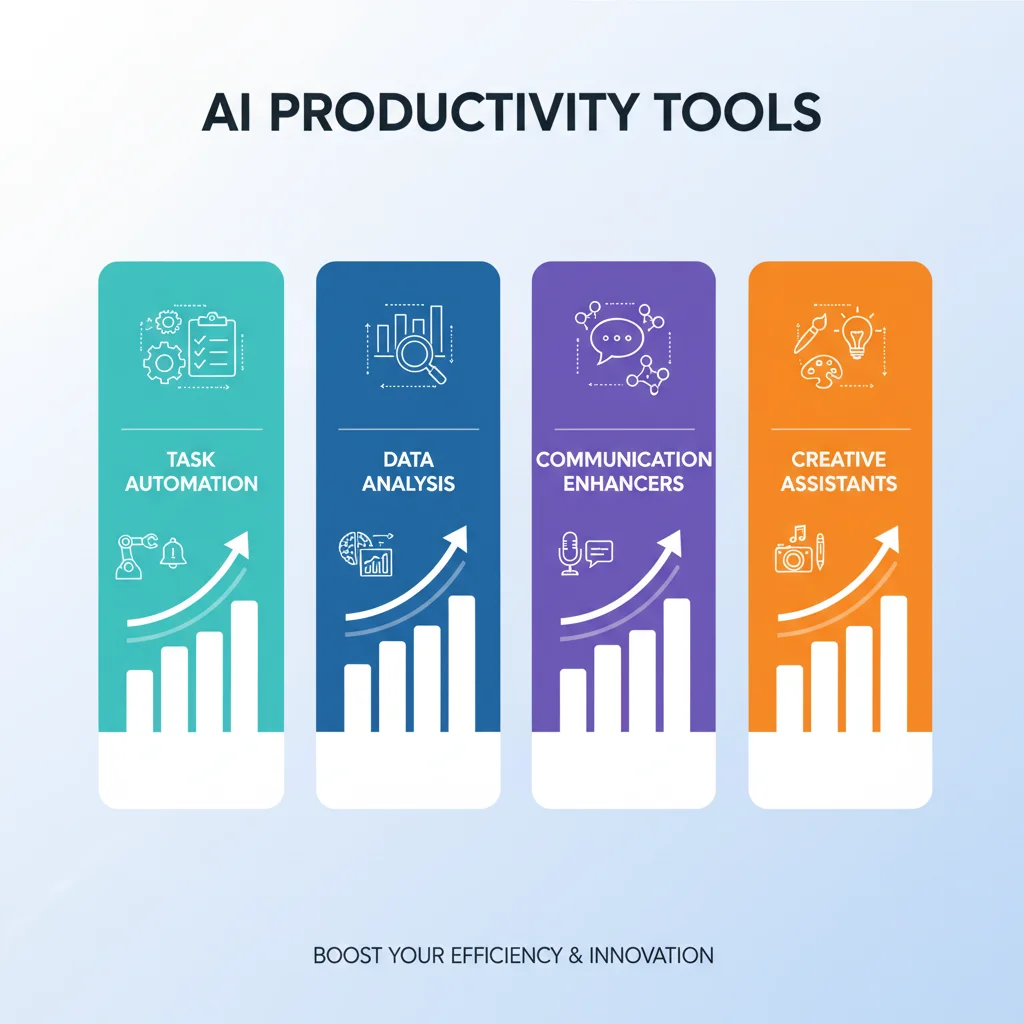
4. Content Creation & Marketing AI
The creative industries are also seeing a massive boost from AI productivity tools.
- AI Writing Assistants: Tools like Jasper, Copy AI, and Grammarly Business can generate marketing copy, blog posts, social media updates, and even long-form content, helping content creators overcome writer’s block and scale their output. They also offer advanced grammar and style suggestions.
- AI Design Tools: Platforms like Canva’s AI features and Adobe Sensei provide intelligent recommendations for layouts, color schemes, and image selection, and can even automate repetitive design tasks, allowing designers to focus on creative vision.
- Personalized Marketing Engines: AI analyzes customer behavior to deliver highly personalized content, product recommendations, and advertisements, significantly improving conversion rates and customer engagement.
5. Project Management & Task Prioritization AI
Keeping projects on track and tasks prioritized is a constant challenge that AI is addressing.
- Smart Project Scheduling: AI-powered project management software (e.g., Asana, Jira with AI plugins) can analyze project dependencies, team availability, and historical data to suggest optimal timelines, identify potential delays, and reallocate resources dynamically.
- Intelligent Task Prioritization: These tools learn individual work habits and project requirements to suggest the most impactful tasks to focus on, helping users manage their workload effectively and avoid burnout.
- Resource Optimization: AI can analyze skill sets, workloads, and project demands to recommend the best team members for specific tasks, ensuring optimal utilization of human resources.
Real-World Impact: Case Studies of AI Productivity Tools in Action
The theoretical benefits of AI productivity tools are compelling, but their real power lies in their tangible impact on businesses and individuals. Here are a few illustrative examples:
Case Study 1: Streamlining Customer Support at a Tech Startup
A rapidly growing tech startup faced overwhelming customer support inquiries, leading to long response times and frustrated customers. By implementing an AI-powered chatbot and intelligent routing system, they were able to automate 60% of routine inquiries, such as password resets and FAQ questions. The AI also analyzed incoming tickets and routed complex issues to the most appropriate human agent, significantly reducing resolution times. The result? A 25% increase in customer satisfaction and a 15% reduction in support staff workload, freeing up agents to handle more critical, nuanced customer interactions.
Case Study 2: Boosting Marketing Content Production for an E-commerce Brand
An e-commerce brand struggled to produce enough high-quality product descriptions, blog posts, and social media content to keep up with their expanding product catalog and marketing campaigns. They adopted AI writing assistants and AI design tools. The AI writing tools generated first drafts of product descriptions and blog outlines in minutes, which human content creators then refined. AI design tools helped with creating numerous ad variations and social media graphics. This led to a 40% increase in content output and a 10% improvement in conversion rates due to more personalized and engaging content. The creative team reported feeling less overwhelmed and more focused on strategic content planning.
Case Study 3: Optimizing Financial Reporting in a Mid-sized Enterprise
A mid-sized enterprise spent considerable time each month manually consolidating financial data from various departments and generating reports. They integrated an AI-powered data analytics platform that automatically pulled data from their ERP, CRM, and accounting systems. The AI then generated customized financial reports, identified discrepancies, and even highlighted potential areas of concern or opportunity. This automation reduced the time spent on monthly reporting by 70%, allowing their finance team to shift their focus from data compilation to in-depth financial analysis and strategic forecasting. The accuracy of reports also significantly improved, leading to better financial decisions.
Challenges and Considerations for Adopting AI Productivity Tools
While the benefits of AI productivity tools are clear, their successful implementation requires careful consideration of potential challenges:
Data Privacy and Security
Many AI tools require access to sensitive data to function effectively. Organizations must ensure that any AI solution they adopt complies with data privacy regulations (e.g., GDPR, CCPA) and has robust security measures in place to protect proprietary and personal information. Trust in the AI system is paramount.
Integration Complexity
Integrating new AI tools into existing IT infrastructure can be complex. Compatibility issues, data migration, and the need for custom APIs can create hurdles. It’s essential to choose tools that offer seamless integration capabilities or to invest in proper integration planning and support.
Ethical Implications and Bias
AI models are trained on data, and if that data is biased, the AI’s output can also perpetuate or even amplify existing biases. Companies must be vigilant in auditing their AI systems for fairness and transparency, especially in areas like hiring, lending, or customer profiling. Ethical guidelines for AI development and deployment are becoming increasingly important.
Skill Gaps and Training
While AI productivity tools are designed to simplify tasks, employees still need to be trained on how to effectively use and interact with them. There may be a need for upskilling the workforce to leverage AI’s full potential, moving roles from purely operational to more supervisory and analytical.
Over-reliance and Loss of Critical Thinking
There’s a risk that over-reliance on AI could diminish human critical thinking and problem-solving skills. Employees should be encouraged to use AI as an assistant, not a replacement for their own judgment and expertise. The human element remains vital for creativity, empathy, and complex decision-making.
The Future is Now: Trends Shaping AI Productivity in 2026 and Beyond
The evolution of AI productivity tools is far from over. Several exciting trends are poised to further revolutionize workflows:
Hyper-Personalized AI Agents
Imagine an AI agent that understands your work style, preferences, and goals so intimately that it can proactively manage your calendar, prioritize your emails, draft responses, and even anticipate information you’ll need for upcoming meetings. These hyper-personalized AI agents will act as true digital co-pilots, learning and adapting to individual needs over time.
Generative AI for Dynamic Content Creation
Generative AI, already making waves in content creation, will become even more sophisticated. By 2026, it will be able to produce not just text and images, but entire interactive presentations, personalized learning modules, and even basic code snippets based on high-level prompts. This will dramatically accelerate content pipelines across industries.
AI-Enhanced Immersive Work Environments
The integration of AI with virtual reality (VR) and augmented reality (AR) will create immersive work environments. Imagine collaborating with colleagues in a virtual meeting room where AI translates conversations in real-time, projects 3D models for review, and provides instant data visualizations, making remote collaboration as effective as in-person interaction.

Proactive AI for Predictive Maintenance and Problem Solving
Beyond simply automating tasks, future AI will be more proactive. In manufacturing, it could predict equipment failure before it happens, scheduling maintenance automatically. In project management, it could identify potential roadblocks and suggest solutions before they impact deadlines. This shift from reactive to proactive problem-solving will save immense resources and prevent costly delays.
Ethical AI and Trust Frameworks
As AI becomes more pervasive, the focus on ethical AI development and deployment will intensify. We will see the emergence of robust trust frameworks, transparent AI models, and regulatory bodies ensuring that AI is used responsibly and for the benefit of humanity. This will build greater confidence in adopting even more advanced AI productivity tools.
Implementing AI Productivity Tools: A Roadmap to Success
For organizations looking to harness the power of AI productivity tools, a structured approach is key:
- Identify Pain Points: Start by pinpointing specific areas in your current workflows where manual effort is high, bottlenecks occur, or efficiency is low. These are prime candidates for AI intervention.
- Research and Pilot: Don’t jump into a full-scale implementation. Research various AI tools that address your identified pain points. Conduct small-scale pilot projects to test their effectiveness, ease of integration, and user adoption.
- Start Small, Scale Gradually: Begin with automating simple, low-risk tasks to build confidence and gather internal champions. As you see success, gradually expand AI integration to more complex workflows.
- Invest in Training and Upskilling: Provide comprehensive training to your employees on how to use AI tools effectively. Focus on how AI can augment their roles, not replace them, fostering a positive attitude towards technology adoption.
- Monitor and Optimize: AI implementation is not a one-time event. Continuously monitor the performance of your AI tools, gather feedback from users, and optimize configurations to maximize their impact on productivity.
- Establish Governance and Ethics: Develop clear guidelines for AI usage, data handling, and ethical considerations. Regularly audit AI systems to ensure fairness, transparency, and compliance.
- Foster a Culture of Innovation: Encourage employees to experiment with AI and identify new opportunities for automation and enhancement. A culture that embraces technological change will be more resilient and adaptable.
Conclusion: The Unstoppable March of AI Productivity
The landscape of work is undergoing an irreversible transformation, driven by the relentless innovation in artificial intelligence. By 2026, AI productivity tools will not just be an advantage but a fundamental component of efficient and effective operations. The promise of a 15% increase in productivity is well within reach for those who strategically embrace these technologies. From automating the mundane to generating profound insights, AI is empowering individuals and organizations to transcend traditional limitations and unlock unprecedented levels of potential.
The future of work is collaborative, intelligent, and highly optimized. By understanding the practical solutions that AI offers, addressing the associated challenges, and proactively planning for its integration, businesses and professionals can position themselves at the forefront of this revolution. The time to invest in AI productivity is now, ensuring that you are not just keeping pace with change, but actively shaping the future of how we work.