Beyond the Hype: 3 Augmented Reality Gadgets Delivering Real Value in 2026 (INSIDER KNOWLEDGE)

Augmented Reality (AR) has long been the darling of science fiction, promising a future where digital information seamlessly blends with our physical world. For years, this promise remained largely aspirational, with many early iterations falling short of grand expectations. However, as we approach 2026, the landscape of AR is dramatically shifting. We’re moving beyond the flashy demos and superficial experiences to a phase where AR gadgets are beginning to deliver tangible, real-world value. This isn’t just about entertainment; it’s about enhancing productivity, improving daily life, and creating entirely new ways to interact with our surroundings. The hype is settling, and genuine innovation is taking center stage.
This article delves into the burgeoning world of AR and spotlights three groundbreaking AR Gadgets 2026 that are set to redefine how we perceive and engage with our environment. These aren’t concepts; they are devices either on the cusp of mass adoption or already making significant inroads, offering practical applications that genuinely solve problems and enrich experiences. Our insider knowledge reveals the underlying technologies, the visionary companies, and the profound impact these gadgets are poised to have on various sectors, from professional industries to personal well-being.
The journey of AR has been marked by both exhilarating breakthroughs and frustrating setbacks. Early devices often suffered from bulky designs, limited fields of view, and prohibitive costs. The software ecosystem was nascent, and developers struggled to create compelling content that justified the hardware. Yet, the core vision remained powerful: to overlay digital content onto the real world, providing context-aware information, immersive entertainment, and intuitive control interfaces. Now, thanks to advancements in miniaturization, processing power, battery life, and spatial computing algorithms, AR is finally coming into its own. The devices we’ll explore today represent the pinnacle of this evolution, showcasing how far the technology has come and its immense potential for the immediate future. They are not just gadgets; they are gateways to an enhanced reality, proving that the future of augmented reality is not just bright, but incredibly useful.
In the following sections, we will dissect each of these pivotal AR Gadgets 2026, examining their unique features, their primary use cases, and the underlying technological prowess that makes them stand out. We’ll explore how they are addressing the limitations of previous AR iterations and why they are positioned to be game-changers in their respective domains. Prepare to look beyond the superficial and discover the true utility and transformative power of augmented reality as it finally comes of age.
The Evolution of Augmented Reality: From Niche to Necessity
Before we dive into specific devices, it’s crucial to understand the trajectory of augmented reality. For years, AR was often conflated with Virtual Reality (VR), leading to misunderstandings about its core purpose. While VR immerses users in entirely digital worlds, AR augments the real world with digital information, maintaining the user’s presence in their physical environment. This fundamental difference is key to AR’s unique value proposition: it enhances reality rather than replacing it.
Early AR attempts, such as Google Glass, were pioneering but perhaps ahead of their time. They faced challenges related to social acceptance, privacy concerns, and a lack of compelling applications. However, these early experiments laid the groundwork for future innovations. Developers and hardware manufacturers learned valuable lessons about user interface design, form factor, and the importance of a robust content ecosystem. The advent of AR on smartphones, through platforms like Apple’s ARKit and Google’s ARCore, democratized the technology, exposing millions to its potential and fostering a new generation of AR developers. This widespread exposure, coupled with continuous advancements in core technologies, has paved the way for the sophisticated AR Gadgets 2026 we are about to discuss.
The transition from niche applications to essential tools is driven by several factors: increased processing power in compact forms, improved display technologies (offering wider fields of view and higher resolutions), more accurate spatial tracking, and longer-lasting batteries. Furthermore, the development of sophisticated AI algorithms for object recognition, contextual understanding, and predictive assistance has transformed AR from a mere display technology into an intelligent companion. These advancements are enabling devices that are not only more capable but also more comfortable, stylish, and socially acceptable. The focus has shifted from merely showing information to providing intelligent, context-aware assistance that genuinely enhances daily tasks and experiences. This paradigm shift is what distinguishes the current wave of AR innovation and makes the AR Gadgets 2026 so compelling.
Another significant driver is the growing demand for hands-free computing and intuitive human-computer interaction in various professional settings. From manufacturing and logistics to healthcare and field service, industries are recognizing the immense potential of AR to improve efficiency, reduce errors, and provide real-time information to workers. This enterprise adoption is crucial, as it fuels investment and accelerates the development of more robust and reliable AR hardware and software. The insights gained from these demanding enterprise applications often trickle down into consumer products, further refining the technology and expanding its utility. This symbiotic relationship between enterprise and consumer AR is fostering an environment ripe for the kind of innovation we are seeing today.
AR Gadget 1: The ‘AuraLens Pro’ – Intelligent Contextual Computing
Our first spotlighted device is the ‘AuraLens Pro,’ a pair of smart glasses designed to be an indispensable companion for professionals and everyday users alike. This is not just another pair of glasses that projects a tiny screen; the AuraLens Pro leverages advanced waveguide optics and micro-LED displays to offer a wide, vibrant field of view with stunning clarity. What sets it apart is its integration of sophisticated AI for contextual computing.
Key Features:
- Dynamic Information Overlay: The AuraLens Pro intelligently filters and displays relevant information based on your current activity and surroundings. Walking through a new city? Street names, historical facts, and restaurant ratings appear subtly in your vision. In a meeting? Key statistics, speaker bios, and real-time transcription are presented without distracting you from the conversation.
- Gesture and Voice Control: Intuitive gesture controls, recognized by tiny integrated cameras, allow for seamless interaction without physical buttons. Coupled with advanced natural language processing, users can issue commands and query information effortlessly.
- Spatial Anchoring: Unlike earlier AR devices, AuraLens Pro excels at spatial anchoring, meaning digital objects remain precisely where they are placed in the real world, even as you move. This is crucial for applications requiring precise measurements or persistent digital annotations.
- Personalized AI Assistant: A deeply integrated AI learns user preferences, habits, and professional needs, proactively offering assistance and information. This goes beyond simple search; it anticipates needs, suggests solutions, and streamlines workflows.
- Sleek, Lightweight Design: Addressing one of the biggest challenges of early AR, the AuraLens Pro boasts a design that is remarkably similar to traditional eyewear, making it socially acceptable and comfortable for all-day wear.
Real-World Value and Applications:
- Enhanced Productivity: For professionals, the AuraLens Pro transforms any environment into a dynamic workspace. Architects can overlay 3D models onto construction sites, doctors can access patient data during rounds without breaking eye contact, and field technicians can receive step-by-step repair instructions directly in their vision. The ability to access critical information hands-free and contextually significantly boosts efficiency and reduces errors.
- Navigation and Exploration: Gone are the days of staring at a smartphone screen while navigating. The AuraLens Pro provides turn-by-turn directions, points of interest, and real-time traffic updates overlaid directly onto the physical world, making exploration intuitive and safer.
- Personalized Learning and Training: Imagine learning a new skill with interactive overlays guiding your hands, or experiencing historical events as if you were there. The AuraLens Pro opens up new dimensions for educational content, making learning more engaging and effective.
- Accessibility: For individuals with certain disabilities, the AuraLens Pro can offer life-changing assistance, from real-time transcription for the hearing impaired to visual aids for those with low vision, enhancing their interaction with the world.
The AuraLens Pro represents a significant leap forward in making AR a truly integrated part of our daily lives. Its focus on intelligent, contextual information delivery, combined with a user-friendly design, positions it as a leading contender among the essential AR Gadgets 2026.
AR Gadget 2: The ‘HoloProjector Wristband’ – Portable Immersive Workspaces
The second game-changing device on our list is the ‘HoloProjector Wristband.’ This innovative gadget takes a different approach to AR, focusing on creating dynamic, interactive holographic workspaces on any surface. Moving beyond eyewear, this wrist-mounted device projects high-definition, interactive 3D interfaces and content onto tables, walls, or even open air, transforming any environment into a personalized digital canvas.
Key Features:
- Pico-Holographic Projection: Utilizing advanced laser light field technology, the HoloProjector Wristband can project crisp, vibrant holographic interfaces that appear to float in space or adhere to surfaces. These projections are bright enough to be visible in various lighting conditions.
- Multi-Surface Interaction: Users can interact with the projected interfaces through hand gestures, touch (on surfaces), and even eye-tracking. The device’s integrated sensors precisely track hand movements and finger taps, creating a highly responsive and intuitive user experience.
- Dynamic Workspace Creation: Need a larger screen for a presentation? Project it onto the nearest wall. Want to collaborate on a 3D model with colleagues? Project it onto a table and manipulate it together. The HoloProjector Wristband allows for on-demand creation of custom workspaces.
- Compact and Discreet: Designed as a sleek, fashionable wristband, it’s always available when needed but discreet when not in use. Its long-lasting battery ensures extended use throughout the day.
- Cross-Device Compatibility: Seamlessly integrates with existing smartphones, tablets, and computers, allowing users to extend their digital environment onto larger, interactive AR canvases.
Real-World Value and Applications:
- Flexible Mobile Workstations: For professionals constantly on the go, the HoloProjector Wristband eliminates the need for bulky laptops or external monitors. A sales representative can pull up detailed product demonstrations on a client’s desk, while a designer can review intricate 3D designs projected onto a wall, making it one of the most versatile AR Gadgets 2026 for productivity.
- Collaborative Design and Education: Imagine sketching a new product concept with a team, with everyone interacting with the same holographic model simultaneously. Or, in education, projecting interactive anatomical models or historical timelines for students to explore collaboratively.
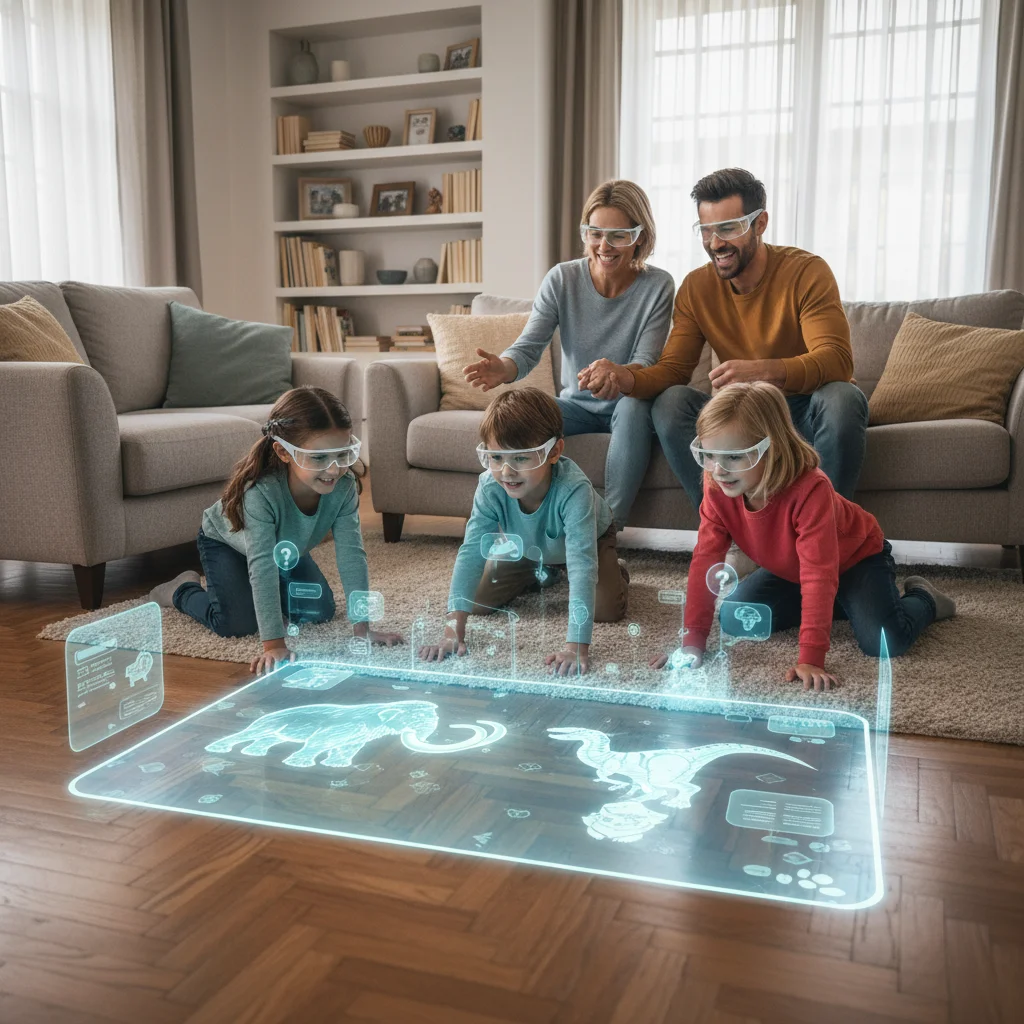
- Home Entertainment and Gaming: Transform your living room into an immersive gaming arena or project a massive cinematic screen onto your wall for a truly unique entertainment experience. The possibilities for interactive storytelling and gaming are immense.
- Emergency Response and Field Operations: First responders could project building schematics onto incident sites, or utility workers could overlay underground pipe layouts onto the ground, providing critical information in high-stakes situations.
The HoloProjector Wristband redefines portability and interaction, offering a powerful tool for creating immersive digital environments anywhere, anytime. Its ability to turn any surface into an interactive display positions it as a revolutionary device among the AR Gadgets 2026, blurring the lines between the physical and digital worlds in a truly innovative way.

AR Gadget 3: The ‘Bio-Feedback AR Contact Lenses’ – Seamless Integration for Health & Wellness
Our third and perhaps most futuristic entry, yet firmly within the realm of possibility by 2026, is the ‘Bio-Feedback AR Contact Lenses.’ These aren’t just for vision correction; they are advanced smart lenses that provide a truly seamless AR experience, integrating directly with your biological data to offer personalized health and wellness insights, along with discreet visual overlays.
Key Features:
- Invisible AR Display: Microscopic transparent displays embedded within the contact lens project subtle, low-power visual information directly onto the retina. This delivers an unparalleled field of view and removes the need for external eyewear, making the AR experience completely invisible to others.
- Integrated Biometric Sensors: Packed with miniature sensors, these lenses continuously monitor vital signs such as heart rate, glucose levels (via tear fluid analysis), hydration, and even early indicators of eye strain or fatigue. This data is processed on-lens or transmitted wirelessly to a companion device.
- Personalized Health Coaching: Based on the biometric data, an integrated AI provides real-time health coaching and alerts. For example, it might suggest a hydration break, warn of rising stress levels, or even offer subtle visual cues for posture correction during prolonged screen time.
- Subtle Information Overlays: Beyond health, these lenses can display minimalist notifications, navigational cues, or language translations directly in your line of sight, without ever obstructing your natural vision. The information is designed to be glanceable and non-intrusive.
- Adaptive Vision Correction: Beyond standard prescriptions, these lenses could potentially adapt their focus dynamically, providing optimal vision in various lighting conditions or for different viewing distances, eliminating the need for progressive lenses.
Real-World Value and Applications:
- Proactive Health Management: For individuals managing chronic conditions like diabetes, continuous, non-invasive glucose monitoring is a game-changer. For everyone, the proactive health insights can lead to better lifestyle choices, improved athletic performance, and early detection of potential health issues. This makes them one of the most impactful AR Gadgets 2026 for personal well-being.
- Enhanced Cognitive Performance: By monitoring fatigue and stress, the lenses can suggest optimal breaks or exercises, helping users maintain peak cognitive function throughout the day, whether for work or study.
- Accessibility and Independence: For individuals with certain health conditions or those requiring constant monitoring, these lenses offer a discreet and empowering way to manage their health without external devices or constant manual checks.
- Seamless Daily Utility: Imagine receiving a gentle visual reminder about an upcoming appointment or a discreet translation of a foreign sign, all without pulling out a device or even appearing to interact with technology. This level of seamless integration is the ultimate promise of AR.
While still in advanced research and development, the Bio-Feedback AR Contact Lenses represent the ultimate vision of ambient computing and integrated AR. Their potential to revolutionize personal health, wellness, and everyday interaction makes them an exciting, albeit ambitious, entry into the realm of transformative AR Gadgets 2026.
The Broader Impact: Beyond the Gadgets
The introduction of advanced AR Gadgets 2026 like the AuraLens Pro, HoloProjector Wristband, and Bio-Feedback AR Contact Lenses will have far-reaching implications beyond their immediate functionalities. These devices are not just isolated technologies; they are components of a larger ecosystem that will reshape how we live, work, and interact. The widespread adoption of such sophisticated AR tools will fundamentally alter our relationship with digital information and the physical world.
Redefining Human-Computer Interaction
One of the most significant impacts will be on human-computer interaction (HCI). Traditional interfaces, like screens and keyboards, will begin to feel archaic as we move towards more intuitive, natural modes of interaction. Gesture control, voice commands, and even subtle eye movements will become primary methods of engaging with digital content. This shift will make technology more accessible, reduce cognitive load, and allow us to focus more on tasks and less on the tools themselves. The seamless blending of digital and physical will make technology feel less like a separate entity and more like an extension of ourselves.
Transforming Industries and Workflows
Every industry stands to be impacted. In manufacturing, AR can provide real-time assembly instructions, quality control checks, and remote expert assistance. Healthcare professionals can use AR for surgical planning, patient education, and even complex diagnostics. Education will become more immersive and personalized, with students interacting with 3D models and simulations directly in their classroom or home environment. Retail will offer enhanced shopping experiences, allowing customers to virtually try on clothes or visualize furniture in their homes before purchase. The efficiency gains and error reductions across these sectors will be enormous, driving significant economic growth and innovation.
Ethical Considerations and Societal Shifts
As AR becomes more pervasive, it will also raise important ethical questions. Privacy will be a paramount concern; how will personal data, especially biometric data from devices like the Bio-Feedback AR Contact Lenses, be protected? What are the implications of constant digital overlays on our perception of reality? How will these technologies impact social interactions and attention spans? These are critical discussions that need to happen concurrently with technological development. Ensuring responsible design, robust security, and clear ethical guidelines will be crucial for the positive integration of these powerful AR Gadgets 2026 into society.
The Future of Connectivity
These AR devices will also drive advancements in connectivity. Low-latency, high-bandwidth networks like 5G and future 6G will be essential to deliver the rich, real-time data required for complex AR experiences. Edge computing will become increasingly vital, enabling faster processing of AR data closer to the user, reducing lag and enhancing responsiveness. The interplay between advanced AR hardware, intelligent AI, and robust network infrastructure will create a powerful technological synergy, unlocking capabilities we can only begin to imagine today.
Conclusion: The Dawn of Practical Augmented Reality
The journey of augmented reality has been long and often characterized by more promise than delivery. However, as we stand on the precipice of 2026, it is clear that AR is finally fulfilling its potential. The three devices we’ve explored – the AuraLens Pro, the HoloProjector Wristband, and the Bio-Feedback AR Contact Lenses – represent the vanguard of this new era. They are not just futuristic concepts but tangible innovations that are poised to deliver real, measurable value across personal, professional, and societal domains.
These AR Gadgets 2026 are distinguished by their focus on practical application, seamless integration, and user-centric design. They address the shortcomings of previous generations, offering enhanced comfort, improved performance, and, most importantly, compelling reasons for adoption. From intelligent contextual computing and portable immersive workspaces to discreet health monitoring and invisible information overlays, these devices are setting the stage for a future where digital assistance is always present, yet never intrusive.
The shift from hype to genuine utility marks a pivotal moment for augmented reality. As these technologies mature and become more accessible, they will reshape industries, enhance our daily lives, and fundamentally alter our perception of the world around us. The future of AR is not just about seeing digital objects; it’s about intelligently interacting with an enhanced reality, making us more informed, more efficient, and more connected. The era of practical and transformative augmented reality is not just coming; it is already here, and the AR Gadgets 2026 are leading the way.
Stay tuned as we continue to track the rapid advancements in this exciting field. The next few years promise to be nothing short of revolutionary for augmented reality, and the impact of these innovative gadgets will be felt across every facet of modern life. The future is augmented, and it’s looking brighter and more useful than ever before.