Subscription Fatigue: Why US Households Are Canceling Services

Understanding the ‘Subscription Fatigue’: Why 1 in 5 US Households Canceled a Service in the Last 3 Months
The modern consumer landscape is undeniably dominated by the subscription model. From streaming entertainment and fitness apps to software and meal kits, subscriptions have woven themselves into the fabric of daily life, promising convenience, access, and often, cost savings. However, a significant shift is underway. Recent data reveals a growing phenomenon often dubbed ‘subscription fatigue explained,’ with a startling statistic: 1 in 5 US households canceled at least one subscription service in the last three months. This isn’t merely a blip; it’s a clear signal of evolving consumer behavior and a challenge for businesses built on recurring revenue.
This comprehensive article will delve deep into the multifaceted concept of subscription fatigue explained. We will explore its root causes, analyze the impact on both consumers and businesses, and critically examine the strategies companies can adopt to navigate this increasingly complex environment. Understanding this trend is crucial not just for subscription providers, but for any business operating in the digital economy.
The rise of the subscription economy was initially met with widespread enthusiasm. Consumers enjoyed unparalleled access to a vast array of services without the upfront cost of ownership. Businesses, in turn, benefited from predictable revenue streams, stronger customer relationships, and valuable data insights. Yet, like any burgeoning trend, saturation and over-extension can lead to unforeseen consequences. For many households, the sheer volume of monthly subscriptions has transitioned from a convenience to a burden, manifesting as ‘subscription fatigue explained.’
What Exactly is ‘Subscription Fatigue’?
At its core, subscription fatigue explained refers to the feeling of being overwhelmed, financially strained, or simply disengaged due to the sheer number of recurring subscription services an individual or household manages. It’s a sentiment that arises when the perceived value of multiple subscriptions diminishes, and the cumulative cost and mental load of managing them become too high.
Think about it: a typical US household might subscribe to several streaming services (Netflix, Hulu, Disney+, HBO Max), music platforms (Spotify, Apple Music), productivity software (Adobe Creative Cloud, Microsoft 365), gaming subscriptions (Xbox Game Pass, PlayStation Plus), news outlets, fitness apps, food delivery passes, and even niche hobby boxes. Each of these represents a separate billing cycle, a distinct set of features, and a recurring decision point. The cognitive burden alone can be substantial, let alone the financial implications.
The Psychological and Financial Toll
The psychological aspect of subscription fatigue explained is often underestimated. Each subscription adds a small layer of administrative overhead. Remembering what you have, when it renews, and whether you’re still using it actively can become a mental chore. This ‘decision fatigue’ contributes to the overall feeling of being overwhelmed. Furthermore, the ‘set it and forget it’ nature of subscriptions, while convenient initially, can lead to consumers unknowingly paying for services they no longer use or value.
Financially, the impact is more direct. While individual subscriptions might seem affordable, their combined cost can quickly escalate, becoming a significant drain on household budgets. Many consumers lose track of their total monthly subscription spend, only realizing the extent of it when reviewing bank statements or facing unexpected charges. This lack of transparency and control over spending is a major driver of subscription fatigue explained.
Key Drivers Behind the Recent Surge in Cancellations
The recent surge in subscription cancellations isn’t accidental; it’s the culmination of several interconnected factors. Understanding these drivers is paramount for businesses seeking to mitigate churn and adapt their offerings.
1. Economic Pressures and Inflation
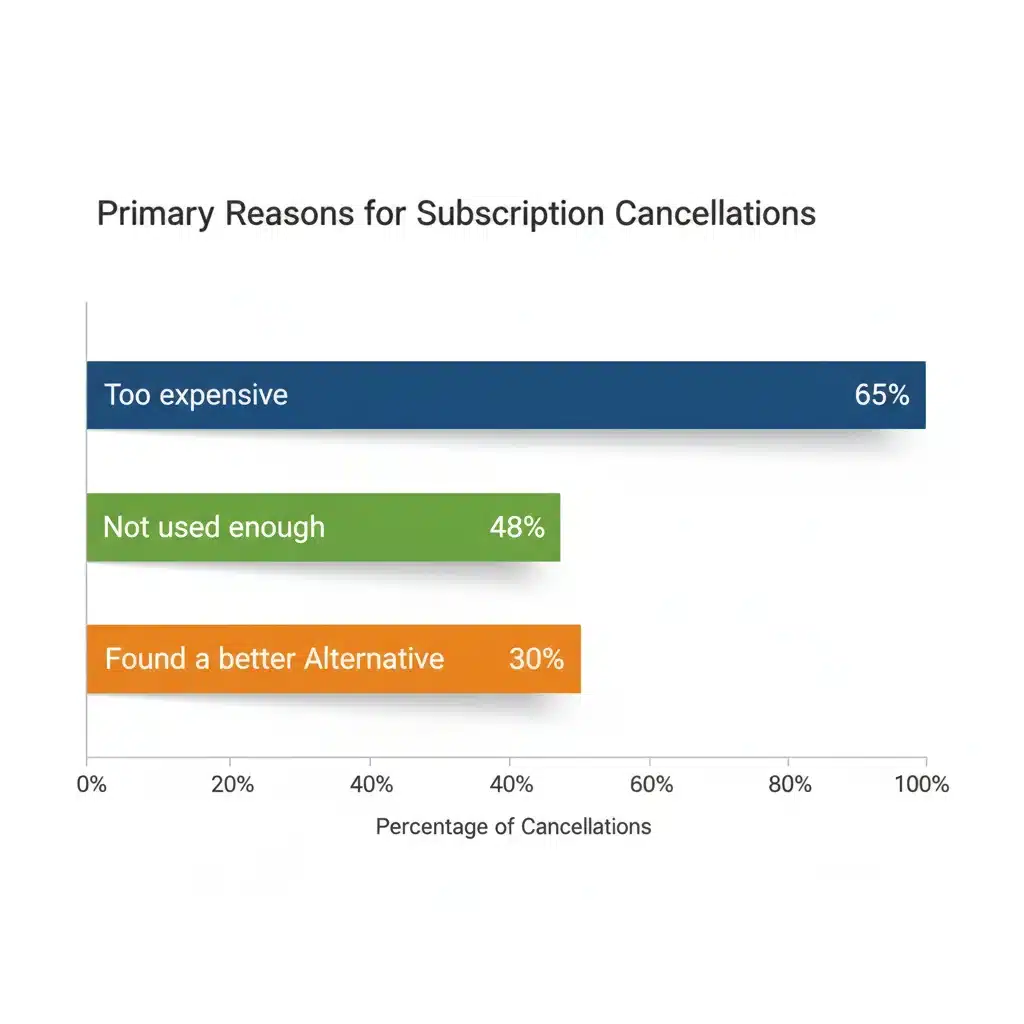
Perhaps the most significant and immediate factor is the current economic climate. Rising inflation has impacted nearly every aspect of consumer spending, from groceries and fuel to housing. As households face tighter budgets, discretionary spending is often the first to be cut. Subscription services, particularly those perceived as ‘luxuries’ rather than necessities, become prime targets for cancellation. Consumers are scrutinizing their outgoings more closely than ever, making value for money a critical determinant.
2. Saturation of the Market
The subscription market has become incredibly crowded. Every major media company, software provider, and even niche content creator seems to have a subscription offering. This saturation means consumers have an overwhelming number of choices, often with overlapping content or features. When faced with too many similar options, the perceived value of each individual service diminishes, exacerbating subscription fatigue explained.
3. The ‘Use It or Lose It’ Mentality
Consumers are becoming more pragmatic. With so many options, they are increasingly evaluating whether they are actively using and deriving sufficient value from each subscription. If a service is rarely accessed, or if its benefits are not immediately apparent, it becomes an easy candidate for cancellation. The ‘fear of missing out’ that initially drove many subscriptions is being replaced by a ‘fear of overspending on unused services.’
4. Ease of Cancellation
While some companies have historically made it difficult to cancel, regulatory pressures and a focus on customer experience have generally made the cancellation process more straightforward. This ease, while beneficial for consumers, means that once the decision to cancel is made, there are fewer friction points to prevent it, contributing to the observed churn.
5. Content Hopping and Trial Exploitation
Particularly in the streaming sector, ‘content hopping’ is a growing trend. Consumers subscribe to a service to watch a specific show or movie, then cancel once they’ve consumed that content, only to subscribe to another service for its exclusive offerings. Similarly, many consumers strategically sign up for free trials, intending to cancel before the paid period begins, further fueling the temporary nature of many subscriptions and contributing to subscription fatigue explained.
6. Lack of Perceived Value and Personalization
If a subscription service doesn’t feel tailored to an individual’s needs or if the content/features provided don’t evolve, consumers can quickly lose interest. Generic offerings in a personalized world often lead to disengagement and, ultimately, cancellation. Businesses need to continuously demonstrate unique value to combat subscription fatigue explained.
The Impact on Businesses: Navigating the New Landscape
For businesses, the rise of subscription fatigue explained presents a significant challenge to their growth models and profitability. High churn rates directly impact revenue, customer lifetime value (CLTV), and investor confidence. Companies can no longer rely solely on acquiring new subscribers; retention has become paramount.
Increased Churn and Revenue Volatility
The most immediate impact is an increase in churn, meaning more subscribers are canceling their services. This directly reduces recurring revenue and makes financial forecasting more difficult. Businesses must now invest more heavily in customer acquisition efforts just to maintain their subscriber base, which can be significantly more expensive than retaining existing customers.
Pressure on Pricing Strategies
With consumers more price-sensitive and scrutinizing their spending, businesses face immense pressure to justify their pricing. Simply raising prices without a clear increase in value is likely to accelerate churn. Companies are forced to re-evaluate their pricing tiers, offer more flexible options, and clearly articulate the value proposition of their services to combat subscription fatigue explained.
The Need for Differentiated Value
In a saturated market, differentiation is key. Generic offerings will struggle to retain subscribers. Businesses must identify and amplify their unique selling propositions (USPs). This could be exclusive content, superior user experience, niche community features, or unparalleled customer support. The ‘me too’ strategy is no longer viable in the face of subscription fatigue explained.
Data-Driven Retention Strategies
To combat churn, businesses need sophisticated data analytics to understand why customers are leaving and to identify at-risk subscribers before they cancel. This involves tracking engagement metrics, identifying usage patterns, and leveraging predictive analytics to proactively intervene with personalized offers, content recommendations, or support.
Strategies for Businesses to Combat Subscription Fatigue
While the landscape may seem daunting, businesses are not powerless against subscription fatigue explained. Proactive and customer-centric strategies can help retain subscribers, reduce churn, and even attract new ones.
1. Focus on Delivering Exceptional Value (and Communicating It)
This is the cornerstone of any successful subscription model. Businesses must consistently deliver value that justifies the recurring cost. This goes beyond the core product; it includes excellent customer service, regular updates, new features, and a seamless user experience. Crucially, this value must be clearly communicated to subscribers through regular updates, personalized emails, and in-app notifications. Remind customers why they subscribed in the first place and highlight new benefits.
2. Implement Flexible and Tiered Pricing Models
One-size-fits-all pricing is increasingly outdated. Offer a range of subscription tiers to cater to different budgets and usage needs. Consider:
- Freemium Models: Offer a basic free version with limited features to attract users and upsell to premium.
- Annual vs. Monthly: Provide discounts for annual commitments to reduce churn and secure longer-term revenue.
- Pause/Downgrade Options: Allow users to temporarily pause their subscription or downgrade to a cheaper tier rather than outright canceling. This acknowledges that life circumstances change and offers a pathway back.
- Bundling: Partner with complementary services to offer attractive bundles that provide greater perceived value.
These flexible options directly address the financial strain contributing to subscription fatigue explained.
3. Enhance Personalization and Customization
Generic experiences contribute to disengagement. Leverage data to personalize the user experience, content recommendations, and even communication. The more a service feels tailored to an individual, the more indispensable it becomes. Allow users to customize their experience, whether it’s content preferences, notification settings, or feature sets.
4. Proactive Engagement and Community Building
Don’t wait for customers to churn. Proactively engage with your subscriber base. This could involve:
- Educational Content: Help users get the most out of your service with tutorials, tips, and best practices.
- Feedback Loops: Actively solicit feedback and demonstrate that you’re listening by implementing user-requested features.
- Community Features: Foster a sense of community around your product, allowing users to connect, share, and support each other. This builds loyalty beyond the core service.
Engaged users are less likely to experience subscription fatigue explained.
5. Simplify Account Management and Billing Transparency
Reduce the administrative burden on your subscribers. Provide a clear, easy-to-navigate account portal where users can view their billing history, manage subscriptions, and update payment methods. Send clear notifications before renewals and price changes. Transparency builds trust and reduces frustration, mitigating a key aspect of subscription fatigue explained.
6. Analyze Churn Data and Act Quickly
Understand *why* customers are canceling. Implement exit surveys, analyze usage patterns of churned customers, and identify common pain points. Use this data to refine your product, marketing, and retention strategies. For example, if many users cancel after a free trial, investigate the onboarding process or the value proposition during the trial period.
7. Focus on Niche Markets and Super-Serving Them
In a saturated market, trying to be everything to everyone can lead to mediocrity. Instead, consider focusing on a specific niche and becoming the undeniable leader in that segment. By super-serving a particular audience with highly specialized content or features, you can create a loyal subscriber base less susceptible to the general phenomenon of subscription fatigue explained.

The Future of the Subscription Economy
The current wave of subscription fatigue explained isn’t a death knell for the subscription economy; rather, it’s a necessary evolution. The market is maturing, and consumers are becoming more discerning. The era of simply offering ‘more’ is over; the future belongs to businesses that offer ‘better’ and ‘smarter.’
Towards Curated and Consolidated Experiences
Expect to see a shift towards more curated and consolidated subscription experiences. This could manifest as:
- Super-Bundles: Large tech companies or content aggregators might offer comprehensive bundles that encompass multiple services under a single, simplified payment.
- Modular Subscriptions: Services might allow users to pick and choose specific features or content modules, paying only for what they genuinely use.
- Usage-Based Pricing: While challenging to implement for all services, a move towards pricing models that correlate more closely with actual usage could gain traction, particularly for software and utility-like subscriptions.
These models aim to reduce the mental and financial burden associated with multiple disparate subscriptions, directly addressing subscription fatigue explained.
Emphasis on Community and Exclusivity
Beyond content and features, subscriptions that foster a strong sense of community or offer truly exclusive access will thrive. This could be exclusive events, early access to products, or direct interaction with creators. Emotional connection and a sense of belonging can be powerful drivers of loyalty.
The Role of AI in Personalization and Retention
Artificial intelligence will play an increasingly critical role in combating subscription fatigue explained. AI can power hyper-personalization, anticipate user needs, identify churn risks, and even automate proactive outreach with tailored offers. Imagine an AI suggesting you pause your fitness app subscription because it detects low usage during a vacation period, only to re-engage you with a personalized workout plan upon your return.
Conclusion: Adapting to a Discerning Consumer
The statistic that 1 in 5 US households canceled a subscription service in the last three months is a powerful indicator that the honeymoon phase of the subscription economy is over. Consumers are no longer blindly accumulating services; they are actively managing their digital portfolios, driven by economic realities and a desire for greater value and control. The phenomenon of subscription fatigue explained is real, and it demands attention.
For businesses, this is not a crisis but an opportunity. An opportunity to refine their offerings, deepen their understanding of customer needs, and build more resilient and customer-centric subscription models. By prioritizing value, flexibility, personalization, and transparent communication, companies can navigate the challenges of subscription fatigue explained and continue to thrive in an evolving digital landscape. The future of the subscription economy belongs to those who adapt, innovate, and truly put the customer at the heart of their strategy.