Subscription Service Audit 2026: Cut Unnecessary Spending by 10% with These 3 Steps

Subscription Service Audit 2026: Cut Unnecessary Spending by 10% with These 3 Steps
In an increasingly digital world, subscription services have become an integral part of our daily lives, both personally and professionally. From streaming entertainment and productivity software to online learning platforms and cloud storage, the convenience they offer is undeniable. However, this convenience often comes at a hidden cost: an accumulation of forgotten, underutilized, or redundant subscriptions that silently drain our wallets. As we step into 2026, the need for a rigorous subscription spending audit has never been more critical. This comprehensive guide will walk you through three essential steps to effectively audit your subscription services, identify unnecessary spending, and empower you to cut costs by a significant 10% or more.
The average household now juggles multiple subscriptions, and businesses, regardless of size, often contend with an even larger portfolio of Software-as-a-Service (SaaS) tools. The ease of signing up for a free trial that seamlessly converts to a paid subscription, or the ‘set it and forget it’ mentality, contributes to this growing financial leakage. Many individuals and organizations are unaware of the true extent of their subscription burden until a financial crunch forces a closer look. Our goal is to proactively address this challenge, providing you with a structured approach to regain control over your recurring expenditures.
By conducting a thorough subscription spending audit, you’re not just saving money; you’re optimizing your resources, reducing digital clutter, and fostering a more mindful approach to consumption. This audit isn’t a one-time task but a healthy financial habit that, when implemented regularly, ensures sustained financial efficiency. Let’s dive into the actionable steps that will help you achieve substantial savings in 2026.
Step 1: Uncover and Consolidate Every Single Subscription
The first and arguably most crucial step in your subscription spending audit is to gain complete visibility into all your recurring payments. It’s astonishing how many subscriptions we sign up for and then completely forget about. This step requires a methodical approach to ensure no stone is left unturned.
Personal Subscriptions: The Digital Footprint
For individuals, start by examining your bank statements and credit card bills for the past 12-18 months. Look for recurring charges, even small ones. Many services offer annual billing, so a shorter review period might miss significant expenditures. Create a spreadsheet or use a dedicated app to list every subscription you find. Include the service name, the monthly or annual cost, the billing date, and a brief description of what the service provides.
- Bank Statements & Credit Card Bills: This is your primary source of truth. Scrutinize every transaction.
- Email Inboxes: Search for keywords like ‘subscription,’ ‘renewal,’ ‘invoice,’ ‘receipt,’ ‘your plan,’ or ‘thank you for your purchase.’ Many services send email notifications.
- App Store & Google Play Subscriptions: Both Apple and Google provide easy ways to view and manage subscriptions linked to your accounts.
- PayPal & Other Payment Processors: If you use these for online purchases, check their recurring payment sections.
- Direct Debits & Standing Orders: Review these directly with your bank.
Don’t forget the seemingly insignificant ones – a $5/month service might not seem like much, but several of them add up quickly. Be diligent; this initial discovery phase lays the groundwork for all subsequent savings.
Business Subscriptions: SaaS Overload Management
For businesses, this step is often more complex due to the sheer volume and variety of SaaS tools. The concept of ‘Shadow IT’ – employees signing up for services without central oversight – can exacerbate the problem. A robust subscription spending audit for businesses demands a multi-faceted approach:
- Centralized IT/Finance Review: Work with your IT and finance departments to pull reports on all recurring software expenses.
- Vendor Contracts: Review all active vendor contracts for SaaS, licenses, and maintenance agreements.
- Employee Surveys: Conduct anonymous or departmental surveys asking employees which tools they use regularly and which they might have signed up for. This can uncover hidden subscriptions.
- Expense Reports: Scrutinize employee expense reports for recurring software purchases or tool subscriptions.
- Cloud Provider Bills: For cloud-based services (AWS, Azure, Google Cloud), review detailed billing to identify all associated services and their costs.
Once you have a comprehensive list, consolidate it into a single, organized document. This can be a spreadsheet (Excel, Google Sheets) or a dedicated subscription management tool. The key is to have all information in one place, making it easy to analyze. Include columns for:
- Service Name
- Vendor
- Monthly/Annual Cost
- Billing Cycle (Monthly, Annually)
- Billing Date
- Purpose/Usage (e.g., ’email marketing,’ ‘project management,’ ‘streaming’)
- User(s) (for business subscriptions)
- Date Subscribed
- Renewal Date
This detailed inventory is your foundation for understanding your current subscription spending audit landscape. Without this clarity, effective decision-making is impossible.
Step 2: Evaluate Usage and Value – The ‘Do I Really Need This?’ Test
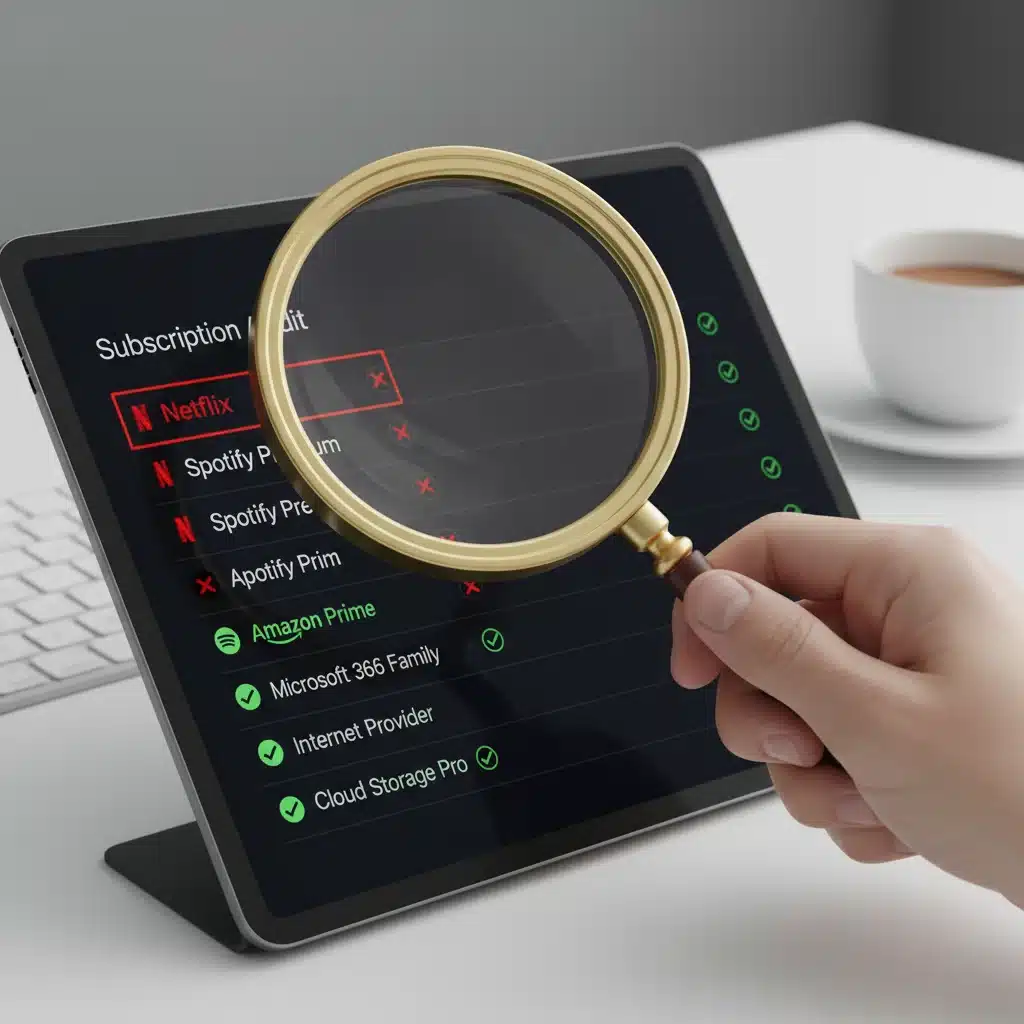
With your comprehensive list in hand, the next step in your subscription spending audit is to critically evaluate each service. This is where you identify redundancies, underutilization, and services that no longer align with your needs or goals. Apply the ‘Do I really need this?’ test to every single item.
Personal Evaluation: Maximizing Individual Value
Go through your personal subscription list and ask yourself the following questions for each service:
- How often do I use this service? Daily, weekly, monthly, rarely, never?
- Do I use all the features I’m paying for? Am I on an expensive plan when a cheaper tier would suffice?
- Does this service provide significant value? Is it essential for work, personal well-being, or a cherished hobby?
- Is there a free alternative that meets my needs?
- Do I have another subscription that offers similar functionality? (e.g., two streaming services with overlapping content, two cloud storage providers).
- When was the last time I used this? If it’s been months, it’s a strong candidate for cancellation.
- Can I get by without it? Be honest with yourself.
Categorize each subscription into one of three buckets:
- Essential: Services you cannot function without (e.g., internet, essential work software).
- Valuable but Reviewable: Services you use and enjoy, but perhaps could optimize (e.g., a streaming service you only watch occasionally, a gym membership you rarely use).
- Unnecessary/Redundant: Services you rarely use, have forgotten about, or where you have a better alternative. These are prime targets for cancellation.
Don’t be afraid to be ruthless. The goal of this subscription spending audit is to eliminate waste. Many people find they are paying for multiple news subscriptions, several fitness apps, or even duplicate cloud storage solutions.
Business Evaluation: Strategic Optimization
For businesses, the evaluation criteria are similar but with an added layer of strategic importance. Each tool should contribute to productivity, efficiency, or revenue generation. Involve relevant stakeholders and department heads in this review process.
- Utilization Rates: Most SaaS tools offer admin dashboards that show user activity. Are licenses being fully utilized? Are there inactive user accounts still being paid for?
- Feature Overlap: Do multiple tools provide the same core functionality? (e.g., two project management tools, two CRM systems). Can one be consolidated?
- ROI (Return on Investment): Is the tool delivering tangible benefits that outweigh its cost? Quantify this where possible.
- Employee Feedback: What do the actual users think? Is the tool user-friendly? Does it meet their needs? Are there frustrations that suggest an alternative might be better?
- Security & Compliance: Does the tool meet current security standards and compliance requirements? Sometimes, an older tool might be a liability.
- Scalability: Is the current plan scalable for future growth, or are you overpaying for features you don’t need yet?
For each business subscription, assign a status: ‘Keep,’ ‘Downgrade,’ ‘Replace,’ or ‘Cancel.’ For ‘Replace,’ identify a suitable, more cost-effective alternative. For ‘Downgrade,’ investigate if a lower-tier plan offers sufficient features. This granular analysis is crucial for a successful subscription spending audit.
Consider negotiating with vendors, especially for long-standing relationships or if you’re considering reducing licenses. Many companies are willing to offer discounts or better terms to retain customers.
Step 3: Take Action and Implement Ongoing Monitoring
The final step in your subscription spending audit is to act on your findings and establish a system for continuous monitoring. Without action, all the hard work in steps one and two is futile. This is where you realize the tangible savings.
Cancellation and Optimization: Personal Savings
Based on your evaluation in Step 2, begin the process of canceling or downgrading subscriptions. Be aware of cancellation policies and notice periods. Some services might require you to cancel several days or weeks before your next billing cycle to avoid being charged.
- Cancel Directly: Most services allow you to cancel through their website or app settings.
- Contact Support: For some services, especially older ones, you might need to call customer support or send an email.
- Downgrade Plans: If you use a service but are on an unnecessarily expensive plan, downgrade to a cheaper tier that meets your actual usage.
- Leverage Free Trials Wisely: If you discover you’re paying for something you rarely use, consider whether a free trial of an alternative could suffice for occasional needs.
- Negotiate: For services you value but find too expensive, sometimes a quick chat with customer service can result in a discount or a better offer, especially if you mention you’re considering canceling.
As you cancel, make a note of the savings. This immediate feedback will reinforce the positive impact of your subscription spending audit. Redirect these saved funds towards your financial goals, whether it’s debt repayment, savings, or investments.
Strategic Cancellations and Vendor Management: Business Efficiency
For businesses, the action phase involves more coordination. Implement the decisions made during the evaluation phase:
- Formal Cancellation Procedures: Follow proper procedures for canceling vendor contracts. Ensure data is migrated or archived as needed before termination.
- License Reduction: Adjust the number of user licenses for tools where utilization is low.
- Vendor Negotiations: Engage with vendors for services you’re keeping. Leverage your audit findings to negotiate better terms, bulk discounts, or consolidated packages.
- Consolidation: If you identified overlapping tools, proceed with consolidating functionality into a single, preferred platform. This often involves data migration and user training.
- Policy Updates: Update internal policies regarding software procurement and subscription management to prevent ‘Shadow IT’ from recurring. Implement approval workflows for new subscriptions.
Document all changes and the resulting cost savings. This data is invaluable for demonstrating the ROI of your subscription spending audit and for future budget planning.

Ongoing Monitoring: Preventing Future Sprawl
A one-time audit, while beneficial, won’t prevent subscription creep from happening again. The final part of this step is to establish a system for ongoing monitoring. This transforms the subscription spending audit from a reactive task into a proactive financial strategy.
- Scheduled Reviews: Set a recurring reminder (e.g., quarterly or bi-annually) to review your subscription list.
- Dedicated Tools: Utilize personal finance apps (e.g., Mint, Rocket Money, YNAB) or business SaaS management platforms (e.g., Zylo, SaaSOptics) that automatically track and categorize recurring expenses.
- Budgeting Integration: Incorporate subscription costs directly into your personal or business budget.
- New Subscription Policy: Before signing up for any new service, ask yourself the critical questions from Step 2. For businesses, enforce a strict approval process for new software.
- Set Calendar Reminders: For annual subscriptions, set a calendar reminder a month before the renewal date to reassess its value.
By making this a continuous habit, you ensure that your subscription spending remains optimized, preventing unnecessary costs from accumulating again. This proactive approach is key to long-term financial health and efficiency.
The Tangible Benefits of a Regular Subscription Spending Audit
Beyond the immediate financial savings, a consistent subscription spending audit offers a multitude of benefits:
- Increased Financial Awareness: You gain a clearer picture of where your money is going, leading to better budgeting and financial planning.
- Reduced Digital Clutter: Eliminating unused services cleans up your digital life, reducing notifications, emails, and unused apps.
- Improved Security: Fewer active subscriptions mean fewer accounts to manage and potentially fewer points of vulnerability for data breaches.
- Enhanced Productivity: For businesses, streamlining tools can reduce context-switching and improve workflow efficiency. For individuals, less digital noise means more focus.
- Environmental Impact: While seemingly minor, reducing data storage and server usage from unused cloud services contributes to a smaller digital carbon footprint.
The target of cutting unnecessary spending by 10% is often just the beginning. Many individuals and businesses discover far greater savings, sometimes upwards of 20-30%, simply by becoming more intentional about their recurring expenses. This percentage can translate into significant funds that can be reallocated to growth initiatives, investments, or simply improving cash flow.
Conclusion: Take Control of Your Recurring Expenses in 2026
The landscape of subscription services will only continue to grow and evolve. Without a proactive strategy, the financial burden of these convenient tools can quickly become overwhelming. By diligently following these three steps – uncovering all subscriptions, critically evaluating their usage and value, and taking decisive action with ongoing monitoring – you can successfully execute a comprehensive subscription spending audit in 2026.
This process is not merely about cutting costs; it’s about intelligent resource allocation, mindful consumption, and empowering yourself or your organization with greater financial control. Start today, and experience the profound impact of optimizing your subscription portfolio. The savings, efficiency, and clarity you gain will be well worth the effort, setting a strong foundation for financial success throughout the year and beyond.
Remember, every dollar saved from an unnecessary subscription is a dollar that can be put to better use, whether it’s fueling personal aspirations or driving business growth. Make 2026 the year you master your subscription spending.